If you’re standing in your driveway hitting the button over and over, you already know something’s wrong, you just don’t know what. The good news is a garage door that won’t open almost always comes down to one of five causes, and most of them are quick, cheap fixes.
Garage Door Won’t Open? Start With These 5 Causes
A garage door that won’t open is almost always one of the following: a dead remote or wall battery, a tripped breaker or unplugged opener, a pulled manual release cord, a blocked or misaligned safety sensor, or a broken spring. The first four are quick checks you can do yourself. A broken spring is the one that needs a professional.
Check the Simple Stuff First
Power and Batteries
- Is the wall opener plugged in and getting power? A tripped breaker is more common than people expect.
- Are the remote batteries dead? If the wall button works but the remote doesn’t, this is almost always it.
- Has there been a recent power outage or brownout? Some openers need to be manually re-synced with the wall switch after a power interruption, even if everything looks normal.
The Manual Release Cord
If someone accidentally pulled the red emergency release cord, the door disconnects from the opener completely and won’t respond to any button, wall or remote. Check for this before assuming anything is broken. To reconnect it, most openers just need the trolley carriage pulled back until it clicks into the opener arm again, then a test cycle to confirm it caught.
Does the Opener Try and Fail, or Do Nothing at All?
| What You See | Likely Cause |
|---|---|
| Opener hums or clicks, door doesn’t move | Broken spring, the opener can’t lift the door’s full weight alone |
| Opener does nothing, no sound or light | Power issue, check the breaker and outlet first |
| Door moves partway and reverses | Safety sensor issue, not a power or spring problem |
| Opener light blinks a specific number of times | Manufacturer error code, check your opener’s manual or model sticker |
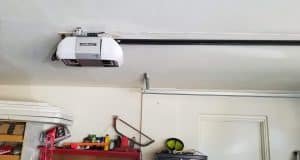
Most opener brands (LiftMaster, Genie, Chamberlain, Craftsman) use a blinking LED on the motor unit to flash a numbered error code when something specific has failed, like a stripped gear or a limit switch problem. If you can access the motor unit safely, count the blinks and check them against your model’s manual before assuming the worst.
Safety Sensors Are a Common, Overlooked Cause
Every opener installed in the last few decades has two sensors near the bottom of the tracks, about 6 inches off the ground. If anything blocks the invisible beam between them, dust, a spider web, a box, a bike, the door can refuse to open or close depending on the model.
Wipe both lenses with a soft cloth and make sure they’re pointed directly at each other. A blinking light on one sensor usually means it’s misaligned or obstructed. Tucson’s dust and dry heat make this a more frequent issue here than in most climates, sensor lenses collect a fine layer of grit faster than homeowners expect, especially in garages that stay open for airflow during summer.
When It’s a Broken Spring
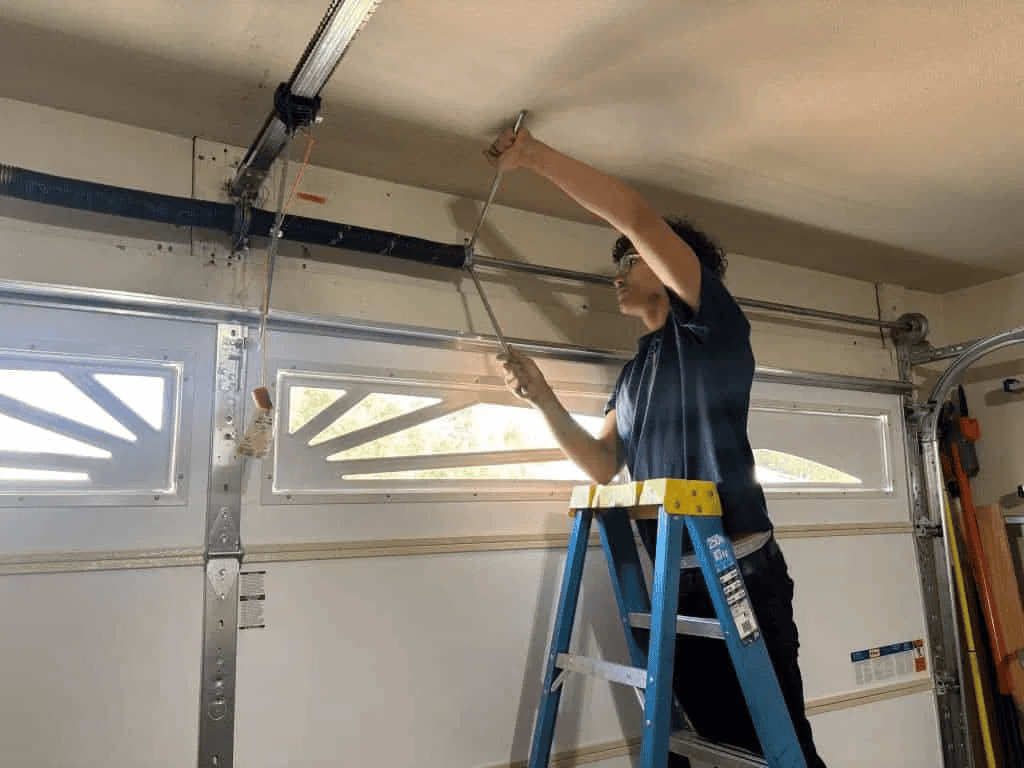
If you heard a loud bang from the garage recently, that was likely the spring snapping. Torsion springs carry most of the door’s weight, and once broken, the door becomes too heavy to lift safely by hand or by opener.
This is the one cause on this list that isn’t a DIY repair. According to national trade figures, professional torsion spring replacement averages around $250, typically in the $150-$350 range for both springs (reputable shops always replace both at once, even if only one broke). Handling springs without the right tools carries real injury risk, a spring under tension can cause serious harm if it releases unexpectedly during a DIY attempt.
If you’re not sure whether it’s the spring, look at the springs themselves, mounted horizontally above the door on a metal shaft. A visible gap in the coil means it’s broken. If you can’t see a gap but the door still won’t budge and the opener strains against it, a technician can confirm it in minutes.
Why This Happens More in Tucson
Extreme summer heat causes metal springs and tracks to expand and contract daily. That constant cycling fatigues the metal faster than in cooler climates, which is why Tucson garage doors can see spring failures a few years earlier than the same door would in a milder region.
The same heat also affects the plastic and rubber components in openers, gears, belts, and seals can become brittle faster under sustained high temperatures, which is part of why opener failures here often show up as a combination of issues rather than one clean cause.
Frequently Asked Questions
Why does my garage door opener hum but the door doesn’t move?
This is the classic sign of a broken spring. The opener motor is running but doesn’t have enough mechanical assistance to lift the door’s full weight.
Can I fix a broken garage door spring myself?
It’s not recommended. Torsion springs are under significant tension and can cause serious injury without the right tools and training.
Why does my garage door open but not close?
Usually a safety sensor issue. Check for anything blocking the beam near the bottom of the tracks, or a sensor bumped out of alignment.
My remote doesn’t work but the wall button does. What’s wrong?
Almost always a dead remote battery or a remote that’s lost its programming.
Is a garage door that won’t open a safety issue?
Depends on the cause. A dead battery is harmless. A broken spring means the door is unsafe to force open or close manually.
How much does it cost to get a garage door diagnosed if I’m not sure what’s wrong?
Most companies, including ours, offer a free diagnostic as part of a service call, so you’re not paying just to find out what the problem is.
Can extreme heat alone cause a garage door to stop working, even without a broken part?
Yes, in some cases. Heat can cause metal components to expand enough that an opener’s safety limits trigger, stopping the door as a precaution even when nothing is actually broken.
Get It Diagnosed the Right Way
If you’ve checked the simple stuff and your garage door still won’t open, Discount Door Service has been diagnosing and fixing these issues across Tucson, Oro Valley, Marana, Green Valley, and Vail since 1999.
Call (520) 579-9084 for same-day service, or use the form below to schedule a free, honest diagnosis.