A commercial overhead door is a moving wall, under spring tension, often tied into alarms, access control, fire rules, dock flow, and employee safety. When it fails at 2 a.m., the problem is rarely only “the motor”. It is usually a chain of small issues that finally tipped over.
In an emergency, the goal is not a pretty repair first. The goal is safe containment, restoring function, and keeping the building secure while trucks, staff, and schedules are piling up. Most bad outcomes happen in the first 15 minutes, when people try to force the door, bypass safety devices, or keep cycling a damaged system until it becomes a bigger failure.
What actually counts as an “emergency” in a commercial bay
Some failures are annoying, some are urgent, and a few are truly dangerous. In commercial settings, “emergency” usually means one of these:
01. Safety risk is active
- Door is off track, hanging, or binding hard
- Cable is fraying, loose, or has jumped the drum
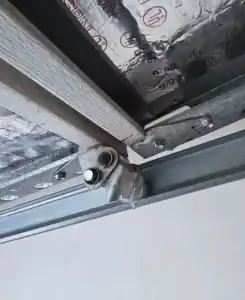
- Bottom bracket area looks bent or torn
- Door free-falls, slams, or will not stay at mid height
- Operator strains, stalls, or makes a loud snap and stop
02. Security or temperature control is compromised
- Door is stuck open at a warehouse, shop, or storage facility
- A bay cannot close and product is exposed
- Refrigerated areas are warming up, faster than expected
03. Operations are blocked
- A dock door is down with trucks staged
- A facility is single-bay, and the bay is dead
- Emergency services access is impacted, in some sites
The rough rule: if people are tempted to “push it anyway,” it is probably emergency enough to stop and control it.
The first 10 minutes: The safe triage that saves your night
When a commercial door fails, the instinct is speed. Speed matters, but sequence matters more.
Step 1: Stop cycling the door
Every extra open-close attempt can turn a small alignment problem into a shredded cable, cracked hinge line, or ruined operator. If the door is jerking, scraping, or leaning, stop it. Don’t “see if it will go one more time”.
Step 2: Keep hands away from the bottom brackets and cables
Bottom brackets and lift cables are not casual parts. They sit in the path of stored spring energy. People grab there because it is at eye level and “looks reachable,” and that is how hands get hurt.
Step 3: Cut power and control stored energy the right way
For a motorized door, power isolation is not optional. Lockout and tagout practices exist for a reason, and emergency repairs are exactly when shortcuts happen. If you have an energy control procedure, follow it. If you don’t, default to isolating power at the disconnect and preventing unexpected movement.
Step 4: Secure the opening
If the door is stuck open:
- Move vehicles away from the opening first, so nobody gets trapped by a sudden drop
- Use temporary barriers, cones, and signage, not just “tell people”
- If you must protect inventory, use a temporary security plan (guard, temporary fencing, internal cage), not improvised chains on the door
Step 5: Document what happened in 60 seconds
A quick photo set helps a lot later:
- Both tracks, bottom corners, cable drums, operator connection, and floor line
- Control box display or error codes, if present
This saves time and reduces arguing later, honestly.
The Failures That Show Up Most in Emergency Calls
Emergency commercial door failures tend to fall into a few repeating buckets. Knowing the bucket helps you decide what is safe to do next.
01. Broken torsion spring or counterbalance failure
Signs:
- Door feels suddenly “heavy”
- Operator hums or stops, door barely moves
- You may see a visible gap in a torsion spring coil
What it means: the door is no longer balanced. Forcing it can burn out the operator or cause a drop risk. A spring break is not a “keep using it carefully” situation.
02. Cable Failure, Cable Jump, or Drum Slip
Signs:
- Door lifts crooked, one side higher
- Loud rubbing at the track, rollers pop
- Cable is loose near the bottom, or wrapped messy on the drum
This is a high-risk scenario. A crooked lift often turns into a door coming out of track.
03. Track Damage and Roller Derailment
Usually caused by impacts, settlement, or hardware loosening over time.
Signs:
- Track is bowed, spread, or the flag brackets shifted
- Rollers show flat spots, wobble, or keep popping
- Door binds at the same height each time
If a track is bent, an emergency tech may stabilize it temporarily, but the right repair typically includes correcting alignment and replacing damaged rollers or hinges too.
04. Operator Drive or Gearbox Issues
Commercial operators take a lot of abuse, especially on high-cycle doors.
Signs:
- Operator runs but door does not move
- Chain is slack, sprocket teeth look sharp or missing
- Gearbox leaks, or the unit sounds rough under load
Sometimes the door is fine, and the operator is the failure point. In emergencies, a tech may switch to a safe manual mode if the system is designed for it, but not all setups are.
05. Safety sensor and control failures that mimic “door is broken”
Photo eyes, monitored edges, and safety circuits can stop a door hard.
Signs:
- Door closes a few inches then reverses
- Operator flashes an error code
- Door works in constant-pressure mode but not in normal mode
These can be faster fixes, but only if the root cause is found, not bypassed.
Why Cycle Counts Matter More than People Think
Commercial doors are rated for a certain cycle life, and many systems are designed around a minimum cycle expectation. The issue is, a “minimum” can be very small compared to a busy facility.
A door that cycles 100 times per day, 5 days a week, hits about 25,000 cycles in a year. If your door is a busy dock, 10,000 cycles can disappear in months, not years. That is why emergency failures feel “sudden” even when the wear was building slowly.
This is also why high-cycle springs and heavier hardware packages exist. They are not upsells in many sites, they are survival parts for real usage patterns.
Conclusion
Emergency commercial garage door repair is part mechanics, part safety discipline, part operations reality. The best outcomes come from one habit: don’t force movement when something looks wrong. Secure, isolate power, document quickly, then repair with a plan.
If your facility has two or three “critical doors,” treat them like critical equipment. The doors will still fail sometimes, but it will happen on your schedule more often, not at midnight with a line of trucks waiting.